Living · Picture Books

Convertibles and Cocoa: A California Christmas Post (with Picture Books)

Winter in Southern California is a bit of a joke. (And right now, huge swaths are burning as wildfires rage, which is no joke at all.) I saw two convertibles with their tops down today, December 18. It was 70 degrees and gorgeous.
As a person who grew up in the mountains and then lived in the Midwest for eight years, I’ve seen enough snow, frankly, but my kids haven’t. So we put inflatable snowmen in our yard, hang plastic icicles from the eaves, and read picture books about winter.
There’s something kind of wonderful about a season of stillness. In my imagination, if not my zip code, winter involves immobility enforced by nature, as if the whole world is telling us to stop for a bit—rest, chat, drink something warm and comforting, and regroup.
(I get a similar feeling whenever the power goes out. What can I say? I’m an opportunist.)
But winter is lovely. It’s the icing on the cake of the year, and an invitation to reflect on what has happened in the last year, and what we want to happen in the coming year. The Roman god Janus, from whose name we get January, has two faces—one looking back and one looking forward. So I try to pause and honor that transition, even where the flowers bloom year round and people wear flip-flops in December.
And here are a few of my favorite snowy books, that we read to remember.
      Winter’s Child, by Angela McAllister, breathtakingly illustrated by Grahame Baker-Smith.   A story of a boy whose grandmother is weakened by the long winter, but who is having so much fun playing in the snow, he wishes it would stay forever—so it does, until he learns about the importance of cycles (Apollo’s creed leaps to mind: Nothing in excess).

 Jack Frost by William Joyce. Joyce’s genius, to my mind, lies in his ability to adapt his work for many media. His Guardians of Childhood series includes novels, picture books, and films, and this one tells the back story of Jack Frost, in all his celestial and icy splendor. Light abounds, and in the winter, it sparkles like magic.
         Santa Claus by Mauri Kunnas, the Finnish author who weaves so much culture and history in to his children’s books.  This is a picture of the title page, not the cover, because I wanted the Aurora, but his books are full of detail and visual jokes. This is Santa’s back story and sort of a Behind-the-Scenes look at the whole Yule season. And yes, this is the same Mauri Kunnas who gave us the spectacular Canine Kalevala, which I regard as one of the greatest literary  achievements of the 20th century. 😊
     Merry Christmas, Matty Mouse, by Nancy Walker-Guye, illustrated by Nora Hilb. This might be the sweetest Christmas story you read this year. It’s about a mouse who bakes cookies at school to give to his mommy, but he gives most of them to hungry friends on the way home. A sweet lesson about generosity and bounty, we read it every year.  And I cry every year. In a good way.
That’s it for this year. Unless I’m compelled by an unpredicted force to write on Christmas Day, I’m taking next week off, and I’ll see you in 2018. May the turning of the year bring light and luck and love to you all.
Teaching

The "I can Google that" Trap

It is a mistake to think we don’t need to remember anything, that we can look everything up.
It’s true the Internet is changing the way we think and learn, but the shift to teaching skills, not content, I think, is misguided.  In English departments (particularly literature programs) we have been told that the way to make our programs relevant and marketable is to teach skills that students can apply in other contexts, rather than worrying that everyone has read the same set of “classics.”
(Before we start arguing, notice I put classics in scare quotes. And understand that I don’t have a hit list or a canon of literature in mind, really. This is an argument for content, but not necessarily for specific content.)
I do think literature teaches important, transferrable skills. Close reading, understanding the context in which a work was written, analytical writing—all of these are good things and all are very useful across the job market.
But it matters, too, perhaps more than we’ve thought recently, as information changes so rapidly that people don’t bother remembering things, that we fill our heads with cool stories and beautiful works. It turns out that having material in our heads is still important.

Memorizing passages is useful. Reading widely and having lots of stories to consider and connect to one another is vital not just to looking well-read (the appeal of which should not be underestimated among English majors). It matters because we use the material, the stories and experiences we have in our memories, to help us move forward.
There has been work on this in multiple areas recently. In an article on how kids’ reading comprehension increases in step when they have exposure to more subjects and experiences (demonstrating that kids’ comprehension skills improve when they have some knowledge of the subject matter they’re reading), Daniel T. Willingham shows that kids who have broader knowledge develop reading skills faster. The more you know, the better you learn.
Another facet of this is the impact of a rich, full head on creativity. When people aren’t
encouraged to memorize anything because literally every subject can be quickly researched on the Internet, we are making it harder to be creative. Art Markman argues in his book Smart Thinking, that the more knowledge you have, the more material in your mind, the more you can mix things up and create something new. Those with less stuff in their heads have less to play with.
When I teach literature I ask my students to think about what other texts (books, movies, video games, whatever) the text at hand reminds them of. We try to build connections between stories and scenes and characters, so that the next time we encounter a Reluctant Hero, we recognize her. It stands to reason that the more stories we have in our heads, the more access points we have to understanding a new text.
But this has wide application, according to these other studies. The upshot seems to be that the more we read, the better we read; the more we learn, the better we learn; and the more we know, the more we can create.
So go on. Build yourself a beautiful constellation of interconnected stories, images, and facts.
Be your own Google.
And here are links to articles I mentioned.  On reading comprehension: https://www.nytimes.com/2017/11/25/opinion/sunday/how-to-get-your-mind-to-read.html?smid=fb-share
Living · Uncategorized

Twenty-Four Tiny Treats

I am an Advent junkie.

I like lots of things about the idea of Advent as it is expressed today. I love the countdown to something wonderful—whether it be the celebration of the birth of Christ, the return of the sun, or the warm fellowship of family and friends. And I seriously think we should count have countdowns more often.

But let’s start with Advent. One of the immediate benefits of this custom is the extension of a shortish holiday in to a long, glorious season. With Christmas, you really just get the two days, and sometimes day and a half, of Christmas Eve and Christmas Day. Kwanzaa celebrates seven days; Hanukkah gives you nine nights. Those few, intrepid traditionalists who celebrate the 12 days from Christmas to the Feast of the Epiphany get—you guessed it—twelve. But Advent lets you double that—24 little celebrations.
And you get those lovely calendars that help you mark your progress. All you have to do is wake up the next day to earn another Advent treat.  Depending on the calendar you use, that treat can be something as small as moving a felt bird from pocket to pocket, to opening doors on a cabin that produce another forest critter for decorations, to drawing out a paper with a different celebratory activity or a holiday story to read, to receiving little presents—candies or toys or tea or whisky.  It’s all good.
In my house, we celebrate a lot. And I plead guilty to both the decorating type and the treat type of Advent calendars. The ritual moment of moving that silly little bird is still lovely.
When my kids were little, we did the activities and the story time.  I stocked little tins with slips of paper that told us to make paper chains and to read Herschel and the Hanukkah Goblins. We had Lego and Playmobil calendars a couple years. We did candy treats the last several years, and I’ve paid for access to electronic Advent calendars with games and interactive scenes.
But we always do something.
There is something powerful about knowing you have a treat coming that turns a normal month in to a time to anticipate and enjoy. Something nearly meditative that brings one in to the moment for a short time each day, as we pause to pull out another critter or munch our treat, to notice where we are in the month and to take a step forward purposefully.
I’m not saying we should have countdowns every month. (I can hear my dad saying if we did it all the time, it wouldn’t be special.) But I am grateful for a tradition that draws out good cheer over weeks instead of hours, that encourages delight in small things, and that forces us to pause and notice our progress.


Enjoy the whole season, y’all.

Reading · Teaching

Skirnir the Wordsmith

There’s a myth in the Poetic Edda, the collection of the oldest Norse myths, where the fertility god Freyr falls in love with the giantess Gerd. He sees her when he sneaks in to Odin’s throne, Hlidskialf, from which Odin can see what’s going on in all the Nine Worlds.
It is not Freyr’s chair.  Sitting in it when Odin is absent is akin to the myths where Cupid sneaks in to Jove’s throne; it is a usurpation of authority.  Freyr is immediately punished by seeing the shiny-bright arms of Gerd, a giantess, and falling immediately in love. I’m not kidding.  He seems to fall in love with her arms.
But before we judge him too harshly for his improper use of authority, his lame fixation on shiny arms, or his layabout sullenness that causes his parents to send a buddy to intervene, we need to remember that this is mythic land, and having Freyr fall in love with someone whose name means (and who therefore really is) the Earth, can only go well for us on Midgard. If the god of fertility loves the earth, we all benefit.
So it’s an old myth. Really old. It’s written in a dramatic dialogue format, so maybe it was performed as part of the rites of spring. If that’s the case, Freyr misbehaving is cosmically good, like Hades stealing Persephone works out for humanity.
But this is not ancient Greece. Here there be giants.
Freyr is mooning. He’s sulky and crabby, and his parents don’t know what to do with him. They enlist Freyr’s friend to go talk some sense in to him. Skirnir, Freyr’s friend, offers to help him, and Freyr confides his love in the most dramatic of terms—no one has ever loved anyone as much as he loves Gerd. He’s so cute; he doesn’t know he sounds like every other smitten boy in the world.
Skirnir knows, though, and he seizes the opportunity. For the low-low price of Freyr’s magic sword that shines like fire and fights on its own, he’ll go “win” Gerd for him. Desperate Freyr agrees quickly.
Gerd, however, doesn’t.
She doesn’t need money or want fame, which are the first offers Skirnir tries. He has to change tactics. He pretends to curse her, by carving runes on a stick.  I love this part. (Not because I’m for coercing women in to marrying their enemies, but because of the explosive image of that rune stick.)
Skirnir claims to carve runes that will become her future, filled with images of shame and suffering.  She’ll be a guardian of Hel; only a three-headed giant will be her mate, yada yada yada–he claims to know how to effect this future by writing it. If he carves it, it will be.
This leads in to unpacking the image of the rune.  Old Norse runes were very angular.  They could be carved easily on a stick, and they could be discerned from sticks cast on the ground like pick-up sticks.  (Does anyone still play pick-up sticks?) The modern German word for “letter” of the alphabet bears witness to this: Buchstabe means literally (ha!) “beech staves.” Buch gives us beech and book, and the sticks that are cast or carved become letters.  Those letters can be combined to form words of power.
In the end, Gerd agrees to marry Freyr. Their union is a mythic promise, that the earth will be fertile always because it is loved by and bound to fertility itself. In this case (not unlike Persephone’s marriage) the end seems to justify the means. Gerd is coerced, but she is not unhappy in her marriage. And humanity gets two boons—a fertile, blessed earth and an understanding of the power of well-wrought words. After all, the title of the myth is not “Freyr and Gerd’s Fantastic Love Story.” It’s called “Skirnir’s Song.”
Teaching

Teaching Reading and Feeling Groovy, I mean, Grateful

I teach in a university department that includes English and Modern Languages, and this is my grateful blog.
I am grateful that I have colleagues in modern languages, and that multiple languages are spoken and taught all around me. I am grateful that the English part of that department includes people who self-identify as Literature people, Rhetoricians, Composition people, and Linguists. Lots of schools have separated those fields in to different departments, and I feel very lucky to have us all together.
The result is that our current curriculum produces very well-rounded English majors; we even called them Linguistic samurai at one point. Our goals (which we articulated carefully as we began to assess whether or not we were meeting them) were to graduate students who read critically and aesthetically, with good attention to context, history, and language, but also who write effectively and powerfully, and who have a good understanding of English and at least one other language.
We value all these skills and attributes, and we think they are interrelated and synergistic.
But I was having a conversation today with a colleague who is a rhetorician, and we talked about different angles we take from our subfields, all sort of aiming at the same broad list of skills. I teach with a primary goal of improving students’ reading, and he teaches with the primary goal of improving their writing. (Some of this is very fuzzy, as he has a literature background, and I have a linguistics background, but it mostly holds.)
When I say I teach reading, though, it’s, shall we say, multivalent. I teach medieval (and older) literature, so sometimes I’m teaching students how to decode older forms of English: “Whan that Aprille, with his shoures soote,/ the droghte of March hath perced to the roote,” for instance. I’m literally helping students to translate Middle English, so to read in the most basic, meaning-making function.
I also help them read aloud, as performance, and that is a different set of skills–one that depends on them knowing the meaning of everything they are reading. I have them memorize and recite in some classes, and perform dramatic readings in others. This all counts as reading, even if it’s lower on the cognitive scale than other ways of reading.
When I teach reading, I also mean that I help students see the context of where a text was written, and how much that matters to the text. If we understand the context in which a text was written, we can understand it more completely and judge it on its own terms, not just ours. So I teach history, culture, the odd bit of archaeology, and some language study (mostly in the form of recognizing cognate words from other languages and understanding the development of English). All of that contributes to reading well and to transferring those skills to other books after my classes are over. I want students to leave feeling nothing is beyond their reach, or too hard/too old/too foreign to read.
I also want them to read critically and to read aesthetically. That is, I want them to be able to think about a text, explain and articulate what they get out of it, and–I think most importantly–to appreciate and enjoy texts that are foreign-sounding or off-putting at first. It matters very much to me that we learn to see the beauty in things we don’t immediately understand; that we appreciate the humor and experience the wonder of texts from cultures remote from ours in place or time.
I think good reading leads to good citizenship and rich lives, and I teach with an eye to finding connections between texts, times, cultures, and people. And I am grateful for books to read, students to read them with, and colleagues to complete their Linguistic Samurai training.
Happy Thanksgiving, everyone.
Uncategorized

How to Hook a Reader, and How Not to: The Fault in Our ARs

This is the second of two blogs on external reading incentive programs and why I think they can’t help but fail, sometimes causing damage as they do. AR is the acronym for Accelerated Reader, the program at use in my kids’ public schools in Los Angeles county, and the beast I fought on the way to raising readers.

There are lots of problems with reading incentive programs, and I addressed my big, philosophical problems three weeks ago: I think the system can be gamed, and if it isn’t, it can do more damage by training kids to read superficially. In this installation I raise some AR-specific (and possibly district-specific) gripes that my kids had to work around.

One problem with AR is that it depends on levels of reading, and when a child’s reading level is established, at least in our schools, kids were unable to read outside of their range. I have trouble with pigeon-holing kids in to levels in the first place, but if it means they are actively discouraged from reading widely, I think it’s doubly awful. 

What gets and keeps kids reading is letting them choose what they want to read, and if you tell them they can’t read something above or below their reading level, two bad things happen. First they lose the benefits of “comfort-reading,” where they read easy stuff that they just enjoy, and second, they are discouraged from really challenging themselves. Sometimes kids are interested in books beyond their ability, and telling them they can’t read them might mean losing a critical moment when they could have fed a passion. Kids learn by reading demanding texts, and if they choose something way beyond their ability, the higher road is to help them through it, rather than tell them it’s too hard for them.

The other loss from limiting kids’ reading choices is that they can’t always read what their friends are reading. This is a huge loss. Kids come in every day talking about what they saw on television or at the movies, and they love to talk to their friends about it. But if they happen to test in to a level way above or way below their friends, they will never be able to talk about the books they have read. We know as adults we love talking about books we’ve read—book clubs are popping up everywhere—but we deny kids that pleasure when we limit the books they can choose to read.

So much is at stake when our kids learn to read. If they love it, they do better in all their coursework. If they love it, they have a lifetime of cheap entertainment and an opportunity to grow continually as they read throughout their lives. If they dread it, they can struggle academically and psychologically. 

Why, then, don’t we do what we know works? Let them choose what they want to read? The short answer is time. Teachers with wide gaps between kids’ skills don’t have time to meet every child where they are and move them gently forward—would that they did. For instance, when my daughter was in 3rd grade, kids in her class were testing at kindergarten to 12th grade reading levels, while all the text books were at third grade level. That means some kids are bored, and some are lost and struggling every single day. (Another answer to that question is that reading programs and other testing companies are BIG business, but I am not that cynical today.)

In the absence of a private tutor, then, a kid needs someone—a parent, a librarian, a friend, just some grown-up who can discuss the books the child reads. Someone needs to listen to what they like, make suggestions for appropriate books, and discuss them afterward. They need to check if the book was too difficult, too scary, too mature, or just right, and follow up with another book.That’s how you hook a reader—show them something amazing, and then tell them there is more… lots more. (If that person could read some aloud, that would be even better, but that is a different blog.)

Ultimately, of course, every kid is different. That’s why they need different books along the way to becoming book worms. We just all need to pitch in; we can’t dump this responsibility solely on teachers. We can all help, putting the right books in to kids’ hands at the right time. That’s a sure-fire way to change the world.
Writing

Beginning the Mabinogion Again

This is an excerpt from a new project I’m working on–a reworking of the Welsh Mabinogion.  It’s just a bit–just because I’m swamped this week and need to use something here that already exists.  I hope you enjoy it; I’m having a blast.

Chapter 1: The Hunt Gone Wrong
Sometimes a hunt is nothing but sweat and dirt and waiting. Not this time. Pwyll’s heart beat in time with his horses’ pounding hooves, and the trail was hot. He was chasing a stag, fast and sleek, and instinctively elusive. But this one wouldn’t get away. This one was white, and stood out in the dark leaves like a beacon, luring his dogs on in to the woods. When something leads you like that, you follow, and you ask questions later.
In and out of trees, the stag seemed to flow like a river, without stumbling or snagging a single branch.  Later he might reflect on that and find it odd, but not in the moment.
Adrenaline pumping, he charged recklessly after the dogs. Five dogs:  there were generally four together and then Finn swerving around, herding them, faster than the others and capable of switching back and steering the whole pack.
The barking was steady for several minutes, and Pwyll’s energy was flagging. He couldn’t keep up this breakneck pace forever. His horse was tired, and so was he. They had to end it soon, or there would be nothing but sweat and dirt to take home. A dog yelped shrilly, and the barking stopped. Finn bayed like they must have cornered the deer, but when the horses caught up with the dogs, what Pwyll saw made his breath catch. The dogs were circling a small mound in a clearing that backed up against a sheer wall of stone. Pwyll quietly said a prayer of thanks that he hadn’t run his horses headlong in to the clearing—they surely wouldn’t have been able to stop in time and would have smashed in to the stone.  The stranger thing still, was the deer had vanished.
Finn looked miserable. He ran the opposite way around the circling dogs, howling, his eyes sweeping the clearing for any trace of his quarry. The dogs sniffed furiously, noses to the ground, one after another around the mound.
“Where’d it go, Finn?” Pwyll asked cautiously. “It didn’t leap up that wall, surely.” Of course not, the dogs’ noses were saying, as they rounded the hillock again.
Pwyll hopped down from his horse and joined the procession of dogs. Finn stopped baying and looked up at him quizzically. “What now?” he seemed to ask. “I don’t know, buddy.”
Pwyll sat down hard on the mound, exasperated, and a puff of dust rose up around him.
Finn sniffed the dust and sneezed. Then he backed up, growling.
“What’s up, Finn?”  The words were just out of his mouth when the dog blurred and shimmered, and the sound of running animals startled Pwyll off the mound.  As he scrambled to his feet, the stag streaked past him, and the dogs took off back in to the woods.  “Where did he come from?” he yelled to no one, and headed back to his horse. He began to swing on to the horse, and a pack of snow white dogs barreled by him, knocking him to the ground.
“There must be twenty of them! Whose are they?” This time he was asking the horse, Llewellen, who snorted indignantly. As they resumed the chase, Pwyll heard the barking, steady and loud and cacophonous, and then it thinned, like fewer dogs were barking. In a few seconds, he understood why—his dogs had been passed up and then left behind. The white dogs were faster, and they had led the quarry away.
“No!” Pwyll shouted, drawing up Llewellen in to a slow trot and letting everyone catch their breath. “And we were so close!  Where did those dogs come from?”  he hounds whined sympathetically, and panted prodigiously. They were worn out. “Let’s go get a drink,” said Pwyll, and he led them over toward the river.
Sweat and dirt again. He sighed. As he walked his horse and his tired dogs through the trees, he thought of excuses he could give for coming up short today. They wouldn’t believe his story about crazy white dogs that appeared out of nowhere. He could already hear Gwyn mocking him.
As he dipped his hands in to the river for a drink, he heard the barking start up again, distantly. They were coming back. He splashed the water on his face instead of drinking it and hopped back on Llewellen. “We might have another chance!” he called, and off they drove in to the trees.
They found the dogs back at the mound, in a pack around the deer, who lay on its side on the earth. “Hah!  Off!  Off!”  He ran his horse in a circle, hooves pounding and breaking up the dogs. Two of the white hounds left the deer and attacked Llewellen. Pwyll stabbed his spear down in to the fray, skimming one on the shoulder and piercing one through the leg.  He swung the dog around by that leg—the dog’s ears were bright red—and tossed him off to the side. He chased the other dogs away from the deer, back in to the woods where he came from.
When he returned, his own dogs were harrying the deer. They knew not to eat the body, but the deer was dead, and they were chewing on its legs and antlers. “That’s enough, guys. Let’s get this beauty home,” he called. He leaped to the ground and knelt to inspect the stag.  “It’s amazing! I’ve never seen anything like it.” The whole pelt was white, except the ears, which were blood red. The eyes, too, open in that awful, frozen stare, were red.  He closed them gently and shook his head. “I’ve really never seen….”
“Of course you haven’t,” came a stern voice from behind him. “It’s not from around here.” A tall, black-clad man on an enormous, heaving stallion stood so close to him, Pwyll jumped. How had he not heard his approach? The horse snorted, and the man leaned down, pulling his hood back off his face, enough to reveal intricately tattooed skin and sunken, fiery eyes.
“Neither am I.”
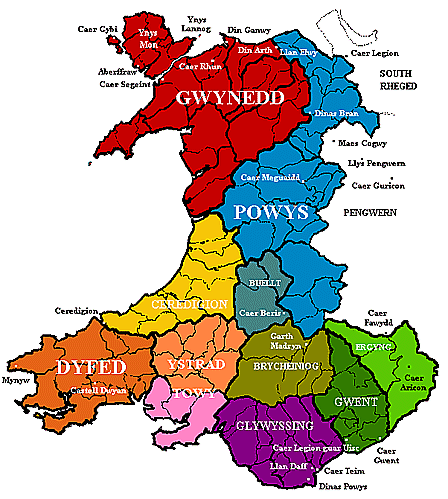
(That’s a map of Medieval Wales, by the way.)
Reading · Teaching

Once More to the Grail

My students are in the midst of their third Grail romance this quarter.  They read Thomas Malory’s account (in Middle English!), Chretien de Troyes’s Perceval, and they are now intrepidly trotting through Wolfram von Eschenbach’s Parzival.
They are doing wonderful work.
They are comparing the object of the grail, and the procession accompanying it.  They’re interested in the different qualities a grail knight requires in each tradition, and in how the character of Percyvalle, Perceval, Parzival differs and stays identifiable.  And they’re doing admirably with the maze of similar but wacky-in-new-ways names. 
They’re trying to get at a core character for Percy.  He’s got to be young, naïve, and not worldly-wise at all.  This innocence seems key to his success in the grail quest.
He still makes plenty of mistakes. His mom tells him to accept love tokens such as rings from fair ladies, so he wrenches the ring off an unwilling maiden.  His next teacher tells him not to ask so many questions, so when the grail castle appears out of nowhere, he witnesses the miracle of the grail, and asking whom it serves would heal the Fisher King and the Wasteland–he stays silent because he’s honoring his teacher.
He seems to apply instruction too literally.  Instruction only gets one so far. Real life is more nuanced than any simple rule can predict.
I think this is why college students like him.  He demonstrates that no matter how well-educated you are, it still matters how you live your life.  You can have bad instructors or great ones, but it matters what you do with your new knowledge. And sometimes the learning curve is pretty gradual: what you have been told takes a while to internalize.
Percy looks on the surface like the “least likely to succeed” in the grail quest, but he lives his way in to the answers (thanks, Rilke!). His experiences shape him, and he fails as often as he wins, but he perseveres.  He apologizes and fixes things when he messes up. He keeps trying to improve himself.
And he achieves the holy grail.
All that remains for us is to do our best, too, then—to own our mistakes and to learn from them, to stand up for people when they need help, to keep going even if we get lost along the way.  It’s not over until the grail castle appears, and the grail castle won’t appear until we’re ready for it.
Innocence, then, isn’t just chastity or virginity. It’s faith that there is order in the universe. We can all achieve that.
Reading

The Problem with Reading Incentive Programs

I have a hard time with reading incentive programs. I remember when I was a kid, and my mom made me read novels for the Read-a-thon, when other kids were reading picture books, and I got creamed, even though I was reading a lot more. I learned that kids will game the system if they’re allowed to.
I was reminded of this when my kids were learning to read. There were the Pizza Hut incentives, but they didn’t work well because we didn’t make it to Pizza Hut very often (like once, maybe). And then there was the Accelerated Reader program. And that took my general disenchantment with external motivation incentive programs to new heights of fury.
I think it’s true that if you set up an external reward system, a significant number of kids will find a way to get the prize without doing the work, and when it comes to reading, the stakes are too high for that.
We want kids to love reading.  If they do, so much is easier for them, and they have a lifelong source of solace and inspiration.  There is a lovely time, right around third grade, where kids are supposed to move from the “learning to read” stage to the “reading to learn” stage, and if they love to read, this period can feel like a rocket launching.
If they don’t, it’s miserable for everyone.
But the solution is not external motivation.  The AR program is a system of points accumulated by taking quizzes over books the child has read.  Let’s start there. That presumes the book has been rated (so it’s worth a certain number of points), and that there is a quiz available to take. The quizzes are content-based, checking recall, and they’re multiple choice.  The system-gamers just got pretty good odds; they can take quizzes without having read or read carefully, and hope to do ok. And the kids who read books that aren’t approved, rated, and quizzed up, can’t get points for reading what they like to read.
In fact, on some questions, kids who haven’t read may do better than the kids who have, because the questions are sometimes so detailed, they don’t have anything to do with the big aspects of plot or character. I remember a question that asked if Clifford the Big Red Dog used a phone pole or a tree to sharpen his claws.  It doesn’t matter, really—you have to know he was a big dog, so he didn’t use a toothpick, but if you couldn’t remember exactly, you could still get plenty from the story.
And look at what else kids are learning: that details matter more than plot.  That what happened is more important than how it made you feel.  That reading superficially–for recall—is good. If they get anything about critical thinking from the new Common Core, they will be spending the rest of their years unlearning these lessons AR taught them.
I teach literature. I do use these kinds of quizzes at the beginning of my classes, so that students have a concrete reason to keep up with the reading. It’s part of their grade, so it keeps them honest when the realities of life threaten their best intentions. I use these quizzes to take attendance; that’s it.  Then I spend an hour or more talking about what the text is really about.
AR keeps these quizzes as an endpoint. When you’re done with the book, the culminating experience is a multiple-choice quiz. I want my kids to get so much more out of books than that. I want them to want to read because they love it—because they get to go places they’ve never heard of, meet people different from themselves and surprisingly similar, learn lessons about human nature and Mother Nature, and hear the beauty of well-wrought words. I want them to understand that when the book ends, their imaginative experience of it does not, and that what is wonderful about a book—what they felt as they read it, what they learned when they talked about it with their friends, and how they will carry its lessons with them–is not ever going to be contained in a quiz.
Living · Writing

Metamorphosis–Giving Myself Permission to Change

I got my fifteen year pin at work. That’s half a career. It feels like a perfect time to shift some gears.
I sometimes have to remind myself not to be afraid of change. I’m pretty good about trying new foods and restaurants, but big changes, I resist. I’m done moving. I chose a career with job security.  I’ve been married to the same guy pretty much all of my adult life.
But I know change is good. I know it’s invigorating, and I know it’s necessary. Since I’m not willing to trade in my husband for another model, it had to be work that changes.
I certainly am not stopping teaching, although some shifts are coming there too, as we change to semesters, and I step out of the King Arthur class and in to some new territory after “semester conversion.”  But this is a multi-faceted job I’m in, so I’m shaking things up in terms of writing.  Really, I’m giving myself permission to revisit a dream.
If you had asked me at fifteen what I wanted to do when I grew up, I’d have said write, and at that point, I’d have meant poetry. I wrote a lot when I was young, but I could never have been so bold as to try to make a career out of writing creatively.
After about twenty-five more years of reading, though, I feel like I have something to write.
It started with a book for my kids. After reading so many books to them, I felt like I could tell where the gaps were, and what worked and didn’t work. But I still wasn’t ready to commit to thinking of myself as a writer.  It took five years to write one little novel. The kids I wrote it for have grown up; that doesn’t sound like I’m a writer—more like a scratcher in the sand.
This year, though, I’m picking up speed. I got awarded a sabbatical to wrap up the novel. That was very validating. I started a blog about reading. It turns out that counts as writing! Before I finished my first novel, I started thinking about the second one. And as I start getting in to critique groups and searching for an agent, I find I have reached a critical mass of baby steps toward a new identity and now don’t feel like an impostor when I call myself a writer.
There is a delicate dance, being a reader and a writer, and we can go from being one to another and back again in an endless circle. I have always considered myself a reader, but only a dilettante writer.  But I have come around to writer again, and this time I’m not begging off.
The best bit of wisdom my dad ever gave me was “If you do what you love, you’ll never work again.”  At the time, I dropped the biology degree and ran headlong in to literature and languages.  And he was right (except for grading). What he forgot is that there can be more than one thing you love.