Living

The Music of a Language

I have the excellent good fortune to teach English in a department of English and Modern Languages.  This means the hall where we live is filled with people who are bilingual and multilingual. It means we have majors in Spanish as well as English, and minors, certificates, and courses in several other languages. It means I hear different languages daily, some of which I can pick out words and follow conversations, and some of which I know next to nothing and can only hear the music. This post is about why that is valuable.
Recently I had a discussion about the sounds of different languages.  You know the stereotypes—Romance languages sound lovely, but Germanic sound harsh, like you’re being yelled at. In fact, it was sparked by this meme:
In some ways that’s not wrong—languages that have a preponderance of words that end in vowels, like Italian or Spanish, sound like the words run together more fluidly, since the vowel of the last word joins to the consonant in the next word just like the syllables do in a single word. This makes the words flow together in a way that the consonant-heavy Germanic languages can’t achieve. In German or English, words more often end in consonants, which means you have to stop the flow of air more often. It sounds like you pause on purpose after each word so you can pronounce them all, and also to differentiate between words. It means you get more of a staccato, shotgun sound as you utter the sentence.
Compare, for instance, part of a line from Dante’s Purgatorio : “Lo sommo er’ alto che vincea la vista…” (Purg. 4.40)–where every word ends in a vowel except the one that’s been abbreviated for the sole purpose of keeping the musical vowel-consonant alteration–with a line from Rilke’s “Evening”: Der Abend wechselt langsam die Gewӓnder,” where the only word that doesn’t end with consonants is an article (‘the’).  Americans tend to view the Italian as more musical and the German as more aggressive, just on the basis of whether there are more vowels or consonants.
Imagine our dismay, then, when we think about English—that glorious bastard tongue of “German spoken with a French accent,” as one of my French professors used to say.  Is it German?  Is it Romance? (English has a whole lot of Latin borrowing as well, and American English is busy borrowing from Spanish as we speak.) So which is it? Both?
The difference for me is not that one is more beautiful than another. (I have heard people be very seductive and debonair in German.) It’s more that they are both musical until we know what they say.  When we have no clue, we can focus on the sound—the lilt of Romance or the rhythm of Germanic. As Jorge Luis Borges says in his gorgeous essay on his blindness, when you don’t know a language, “each word [is] a kind of talisman that [you] unearth.” Each word rings with strangeness and music, and comes out more a chant than a sentence.
This is a reason to study another language. In addition to making you more cosmopolitan, introducing you to other cultures and gaining a better understanding of your own language’s grammar, you get to experience that music. You get to enjoy the process of turning that music in to meaning. Because that’s the problem with listening to a language you already know, particularly natively:  you are so busy making it mean something, you forget to listen to how beautifully it sings.
Reading · Teaching

Transfiguring Grief

I taught the story of Phaethon in my Myth as Lit class last week.  In some ways, it’s become trite:  Young Phaethon gets caught up in his desire to drive his father’s car, to step in to his shoes too soon, and ends up literally going down in flames.  Phaethon’s dad happens to drive the sun, not just a Camaro, so when he goes too high he scorches the heavens, and when he drops too low he sets the world on fire.

Jove, his grandfather, has to shoot him out of the sky with a thunderbolt. Apollo, his father, mourns so that the world is sunk in to darkness, for he is too distraught to go to work. The only light comes from the burning wreckage of the earth. This sounds pretty dramatic as I write, but still the story of Phaethon taking on his dad’s role before he’s ready is pretty well known, and can feel obvious.

I classify it in class as one of the 18-year-old-itis tales—one where the only “tragic flaw” is youth. He is in that period of life when boys (girls too, but statistics bear out mostly boys) start taking big risks without realizing the consequences. When they feel bullet proof.  But they’re not.  And they die.  Icarus falls here too, of course, and for similar reasons—flying too high, too fast.

So that’s why it feels overused, I suppose, because it is. There are lots of stories of young men dying because they underestimate laws of physics and overestimate their own abilities. But reading it this time, I was struck not so much by that lesson, but more by the grieving family he left behind.

In Ovid’s tale, Apollo mourns his son with a depth and a humaneness that staggers me.  When he refuses to show up to work, he cries, “Let someone else/ now guide the chariot that bears the light!/ If none will do that, and the gods confess/ they can’t, let Jove himself take on that task!/ And when he plies my reins, at least for once/ he’ll have to set aside the thunderbolts/ he uses to strip others of their sons.” He is devastated, and he is a god. What chance, then, have the mortals who love Phaethon?

His mother mourns.  She wanders the world looking for a sign of him, any trace of his lost body.  When she finds the grave that nymphs have made for him, she throws herself on it and bathes it in tears.  His sisters follow, and in their grief, they transform in to poplar trees.  The mother loses more children, as she tries to tug at the branches to free them, only to be told the branches are their arms, and she’s hurting them more by holding on. 

A cousin, too, transforms in his sorrow, this time to a swan.  (His name is Cycnus, which means ‘swan,’ and we still have ‘cygnet’ in English, meaning a baby swan.) Ovid uses this and other opportunities to show that we have an underlying nature that can be revealed by transformation. Cycnus wails for Phaethon as a swan, while his sisters are rendered immobile by their grief.  Paralyzed.  They are able only to cry tears of sap, which, beautifully, transform in to amber. Those who could not abide the pain of grief gave themselves over completely. 

This message seems clear to me: grief is transfiguring. If we let it, it can undo us. It always changes us. In the context of Apollo and his creed–Know thyself; and Nothing in excess—we can come to see even grief can be excessive, but the gods also grieve, so there must be something noble in feeling loss so profoundly. 

In the larger context of Ovid’s Metamorphoses, it anticipates the story of Proserpina’s (Persephone) marriage to Pluto, which bonds life to death in an unbreakable union, promising that death will never just be death; there will always be life attending—following in sequence as the seasons follow one another, and living together with death, so we can bear death more easily.

This scene struck me last week when I taught it. It resonates even more today, in the aftermath of the largest mass shooting in recent American history. I hope we let this grief transform us too, and resolve to take action to prevent it happening again.  Young men do lots of crazy things that put their lives at risk, but going to a concert shouldn’t be one of them.
[image from touristorama.com]

Living

Freezing Childhood (with pictures–not Snow Queen-Style)

I was chatting with my friend recently, and she admitted she had over 10,000 pictures of her children.  That is phenomenal, but I suspect not too uncommon today.  I was also chatting on social media about a song by Darius Rucker, “It Won’t Be Like This For Long,” which always makes me sad and a little annoyed that it comments on the phases of childhood like tough times to get through, rather than stages of development and moments we’ll never have again. But in an age where every moment is documented, the passing of these phases seems gentler.
My parents grew up in different circumstances.  My dad was a city kid, the only child of a professional—a bookkeeper (we’d call him an accountant today, I suppose.)  My mom was raised in a series of small towns in Indiana and Ohio, one of seven children.
There are a good number of pictures of my dad, many professionally taken, as a baby, as a young boy, fewer as an adolescent, but then lots when he went off to college and had his own camera. Of my mom, there are fewer–very few formal ones. Lots of kids and few professional photographers make for scarce opportunities. This would have been the 1940s.
A generation before, there are even fewer photos, of course. A generation before that, nothing.  My generation was the one with film.  My dad took lots of pictures of us growing up, and we had slide shows like people watch movies now, as a family, laughing at the funny ones.
Today, though, kids’ lives are hyper-documented.  At last count, I believe we had a bazillion and four pictures of our two kids.  We got a digital camera in 2000, when our first child was a baby.  That changed everything.  My dad tried hard to take good shots because you had to pay to develop every single one. Today, we just shoot and shoot and shoot and shoot.  I actually took 75 pictures of my son in his first Halloween costume.  My husband took some more.  (He was a pea pod, and every one of them was justified.)
But what is the effect of this proliferation of images?  I think we look at childhood differently. It’s true, “it won’t be like this for long,” but we’ll remember it better than ever before.  What must it have been like not to have any photographic evidence of the adorableness of your baby?  On the one hand, it might make one want to slow it down and enjoy it.  On the other hand, it might collapse early childhood in your head to that time when they were cute but not useful, versus the time when they were still young but could start helping out.
We know that the experience of childhood has changed over the centuries—maybe more in the 20th century than ever before. Childhood has been essentially invented in this period—protected with child labor laws, and imagined and cherished in children’s literature, until we have a pretty crystalline idea of a time that should be special and savored. I just wonder if having photographic evidence of those moments isn’t the biggest catalyst for this change.
Teaching

The Once and Future Course

When I started my job, there was only one medieval course on the books: Chaucer’s Canterbury Tales. I was to be the only medievalist, and in fact, even more than that. My job description was technically “Medieval and Renaissance Non-Dramatic Literature,” which meant that we had two Shakespeareans, but I could have Spenser. So in my first few years, I designed courses that fit my interests and Cal Poly’s needs. The Epic. Myth as Literature. Arthurian Romance.
Now that we’re shifting from quarters (which has the advantage of more, if shorter, classes), I find myself facing down my last King Arthur class. Poor Arthur didn’t make the cut to conversion. That’s a hazard at a school with only one medievalist—there are a number of courses that no one teaches but me, and if I’m teaching fewer courses, well….
This makes me pretty sad, but I’ve had a good run.  King Arthur is a subject, a whole field, really, that doesn’t get old. It’s an incredibly productive mythos in Western literature.  From 9th century histories to this summer’s King Arthur: Legend of the Sword, it’s still alive and well in our imaginations, and for good reason.

It starts with magic—with Merlin helping the impassioned King Uther in to another man’s bed, in a move that curries favor and power, but banks it.  Merlin is patient and can wait for Arthur to grow up. In the middle, there’s the rise of Arthur and the Round Table, from his pulling the sword from the stone, to the establishment of his court of champions, all the iconic episodes of which have been told and retold. Perhaps the peak is the unifying (but ruinous for Camelot) Quest for the Holy Grail. And finally, the fall of Camelot, set in motion by the love affair of Sir Lancelot and Queen Guinevere.
You can see why it’s productive.  It’s bloody brilliant, really. First, the life of Arthur is mythically heroic. I mean he fits the model of so many heroes in world literature, with his supernatural birth, his noble roots but obscure upbringing, and so many other mythic traits.  He is an epic hero in the truest sense.
And then he establishes a court. Several of his knights have their own iconic adventures—Gawain with the Green Knight, Percival and the Grail, Tristan and his tragic love for Iseut.  From a marketing standpoint alone, that’s gold.  Arthur has 150 knights.  Their tales could go on forever.
And the Grail thing.  Just think how productive that has been. We use it as a generic magical object now; it’s the Kleenex of questing objects. It was also a quest that united all the court—everyone went. But not everyone came back, and only a few got close to achieving it. A quest like that is like the Expendables franchise—a greatest hits roster, made for fans who will go nuts to see them all together.
And the love story of Lancelot and Guinevere. We don’t even need Arthur anymore. He’s just the center of the circle, holding the tales together. His knights and now even his wife have moved on, but they’d have been nothing without him.

As I teach this course one last time, I’ll focus on that center of gravity that Arthur represents.  And who knows, maybe one day in the future, I’ll work him back in to the curriculum.

Living

What I Did Over Summer Vacation

Not a lot, honestly.

That’s not true—just not what I had in mind to do. I had great plans for a sabbatical project and some travel and a last hurrah of a summer before my institution converts from a quarter system to a semester system next year, and we go back to school in mid-August, rather than late September.

I did do some writing. I did do some reading. But everything else went haywire.
My mother passed away in April. It was a long time coming, and I expected it, I think, every day for the last six years or so, except the day it happened. I have been dreading phone calls for years, especially from anything looking medical, but for some reason, this time when I picked up the phone, it was the farthest thing from my mind. I actually was thinking, “Oh, it must be time for a quarterly review.”
“Hello, Ms. Baker. This is ______.  I’m calling to inform you of your mother’s death.”
First of all, who says that? Shouldn’t she ask me to sit down, or say she has some bad news? Eesh. I did sit down. Abruptly. The breath I let out was a sigh and a moan and a balloon fluttering around in my chest.
No. Not now. Not like this. When my father passed away, I was a thousand miles away, and I got the call that if I wanted to say goodbye, I should come right down. I couldn’t, of course, but they tried. Where was that call this time, when I was twenty minutes away?
This time it was over in a moment. Years of anguish, as she battled Paranoid Schizophrenia, winning some days–losing ground, most days. After years in her convalescent hospital, after more than a year on hospice, and after being completely blind and not particularly noticing, she had only clothes and a few stuffed animals in her possession. I donated them to the convalescent hospital. They didn’t even need me to come down.
All there was left to do was wait for the death certificates and the cremains, both of which would be mailed. “Thank you. Have a nice day. Very sorry for your loss.”

I have been responsible for my parents for the last ten years. Dad had dementia and passed away a year and a half before Mom. Because I had been mourning them for so long, I thought it wouldn’t hit me so hard. It didn’t hit. It sucked.
It sucked the life out of me–all my energy, all my emotion. I couldn’t think or feel or cry or yell. I watched more tv this summer than I have in the last ten years. And those things I said I’d do—I forgot what they were. All my plans involved thinking, and I just didn’t have thinking in me.
I read novels. I watched Netflix. I filled my head with other stories, until I was ready to tell my own. I’m ready now. And being ready to tell my story means I’m ready to work again. I’m ready for the fall quarter. I’m a chapter away from that book being done. I’m taking a fiction writing workshop and looking for an agent.
There are stories to be told about my mom now, and I’ve started spinning some out for my kids. That will continue, now that it makes my heart swell, rather than deflates me, to talk about her, now that she is an exhalation, a soul free in the ether. Deep breaths, deep breaths. Life flows on.
Living

Self-Portrait as Self-Knowledge

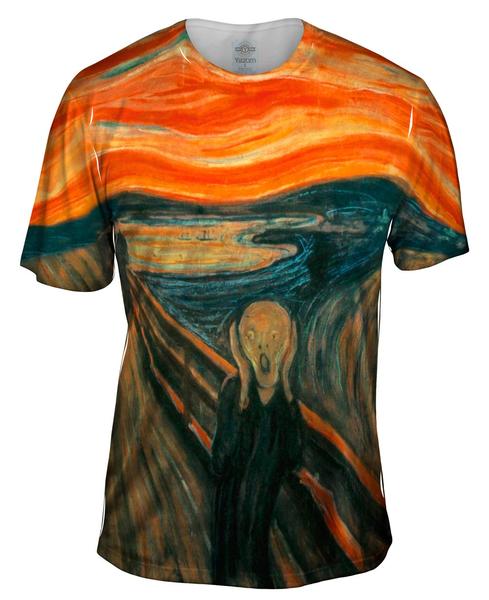
My family and I recently saw an exhibition of Edvard Munch’s work at the San Francisco Museum of Modern Art.  You know Munch, even if you’re not an art lover.  He painted The Scream, which you’ve seen parodied so many ways you might not even recognize the original.  In case it doesn’t leap immediately to your mind’s eye, I present something like the original on a tee shirt, and two parodies to jog your memory.

So that guy.  I always thought he was so dark and creepy, I didn’t really like him. I am quite a sunshiny optimist, really. But an exhibition is a funny thing—it presents a scope of a person’s life like a biography or a long night of storytelling—and by the time I left, I was a hardcore Munch fan.

The first thing I saw was a room full of self-portraits, which was brilliant on the curator’s part, because there’s nothing so personal and public at the same time as a self-portrait. Several of them at once create a flow of time, of stages in a life, in a way that makes one feel like you’ve known this guy forever. You have a sense of who this guy was. He was young; he was middle-aged; he grew old.

Once you’ve seen the artist through his own eyes, you’re ready to see the rest. What the portraits taught me was how he became the creator of The Scream. There were paintings of sick beds (he lost his sister and mother to tuberculosis when he was young) and paintings of houses with lurid skies. You could feel them almost as much as you could see them. The blurbs telling us of his traumatic loss and battles with mental and physical illnesses were almost superfluous.

I came away from this experience thinking my assessment of Munch as dark and creepy had been woefully hasty and superficial. Instead, I was struck by the fact that he was just a man, struggling to live his life like anyone else. I felt his humanity. In the fishbowl of an exhibition, surrounded by images of Munch’s difficult life, I was deeply moved by his fervor to document it—to strip it down to its raw, real elements, and convey them to others. And I got it, man. I felt. Sometimes it was horrible; sometimes it was heartbreaking, but he kept painting. There is heroism in that.
And in the struggle to tell his story, there was intense beauty we can all experience and identify with. In his pile of self-portraits, there was an urgency to figure himself out. We all struggle with knowing who we are and who we want to become (witness all the thousands of internet quizzes that promise to tell us which Muppet or Middle-Earth race we most closesly resemble); Munch was just really persistent in trying.


That seems a worthwhile goal, though—figuring ourselves out. Whether we paint or write or psychoanalyze ourselves, knowing is better than not knowing ourselves. It’s worth it to take stock of where we are and where we’ve been, so we can determine where we want to go next. And after this closer look at Munch’s work, part of me will wonder at every stage, how would I paint this in to my self-portrait? 

(In addition to my panoply of Screams, I collect here Self-Portrait After the Spanish Flu 1909, Self-Portrait with Cigarette 1895, Self-Portrait with Bottles 1938, and Self-Portrait Between the Clock and the Bed 1938.)

Picture Books

The Baby Shower Blog, or Alison’s Favorite Board Books

Hi, my name is Alison, and I disregard baby registries.
I hope someone picks up my slack and gets you the bottles and onesies and Diaper Genie I know you need, but I’m bringing books to your shower.
There is almost nothing that makes me happier than giving books to kids. I feel like that’s one of my callings. I do it as often as opportunity presents itself, and sometimes I create the opportunity.

And after years of experience, I do it pretty well. I’ve read a lot of kids’ books—with my kids, with my students, and in my comfy chair all by myself, and I promise I’ll bring the kind of books you won’t get sick of reading after three times, because it’s important that you have the stamina to read it ten times if your kid wants to hear it ten times.

The market for little kids’ books is glutted with poorly written drivel, with saccharine rhymes and trite morals, because lots of people still write down to kids. I promise to find charming books that make you want to read them. Some that make you happy to make silly noises or silly faces, and some that make you both laugh. Some you can sing, and some that make you sigh. And if you’re interested, as your kiddo grows, I’ll make more suggestions.
Alison’s Starter List of Board Books for Babies:
 
1. Kiss Goodnight (A cuddly “Sam” book by Amy Hest, illustrated by Anita Jeram)
2. Mouse Paint (A color book with a last sentence that rings: “But they left some white because of the cat.” By Ellen Stoll Walsh)
3. Jamberry (An aural and visual feast by Bruce Degen)
4. Is Your Mama a Llama? (An animal book with more than just puppies and kittens—not that there’s anything wrong with puppies and kittens, but let’s face it: it’s a big world—by Deborah Guarino, illustrated by Steven Kellogg)
5. Doggies (A counting and barking book by Sandra Boynton, who could grace this list many times, but I’ll stick with this one because we need to know all the different ways American doggies bark at least as much as we need to know how to count to ten)
6. The Runaway Bunny (Because someone else already bought you Goodnight Moon, but you need this one too, by Margaret Wise Brown, illustrated by Clement Hurd)
7. Freight Train (A book full of color and action and noise and because, as Paul Simon reminds us, “everybody loves the sound of a train in the distance” by Donald Crews) 
8. Grandfather Twilight (A beautiful, calming, winding down sort of book for the end of a busy day, by Barbara Berger)
There are more, but I’ll stop there tonight.  Happy reading.
Reading

Didascalicons, or What to Read and How to Read It

I have always been interested in education, and when I chose to study medieval Europe, it was a natural draw for me to see how they studied and what they valued in terms of learning. When relatively few people were literate, and most of those had strong ties to the church, reading was viewed quite differently from today. Texts were produced laboriously, often by many different artisans, even before one considered the text’s author. Reading was serious work—serious enough that people worried about doing it wrong—with bad intentions or just badly (reading that is superficial or frivolous, not reflective and enlightening). Thus there was a need for a Didascalicon.
Hugh of St. Victor wrote the Didascalicon as instructions toward productive study and correct reading. He includes directions on what texts to read, what areas to study, and what order of subjects leads to fullest understanding. We might presume that the idea of reading rightly may have had more clout when there were fewer readers and fewer texts, and most of them were associated with the church. One should read with the elevation of one’s soul in mind, of course. But I think we still fret about this.
There’s a shift, to be sure.  Dante writes in his Inferno (Canto 5) about a couple who fall in to the sin of lust while reading the tale of Sir Lancelot and Queen Guinevere’s affair. He worries (not unreasonably) that his own books might lead people to sin if they were read badly—quickly, shallowly, or misdirectedly—if they were misinterpreted. The idea that his current book, which he intends to lead readers to salvation, might also lead some to Hell, hits him like a ton of bricks.
But Dante was writing in the Catholic Middle Ages. So was Hugh, a century before him. We live in the 21st century. Surely we don’t need people telling us how to read or what to read.
Or do we? The advantage that medieval readers had over us is the same thing I listed as a deficit above.There were far fewer texts, and the cost of producing a text meant someone had to really want to produce and disseminate that text. That means, if not quality control, at least quantity control was built right in to the system.
Hugh is worried about us reading so that we get maximum gain from what we read, but he’s not worried about our reading texts that are deliberately misleading. No “Alternative Facts” or propaganda in a medieval romance. No Buzz Feed lists and no satire sites that are so carefully crafted that readers have to check their sources to make sure they’re satire.
Face it. We still need help reading. Now we need help knowing what to read, what not to read, and what not to believe, if we do get sucked down a rabbit hole.  We worry about images we can’t “unsee” and spending too much time reading things that really upset us.  The context is different (I think the number of people afraid of being damned for reading something is down, at least per capita), but the result is the same—people worry about wasting time, being misled, and even being psychologically affected  by what they read.
What do we do to combat the overwhelming amount of text and image that we encounter on a daily basis?  We read lists that other people have compiled. Blogs are full of reading recommendations, as is Pinterest. We publish lists of bestsellers, and we award prizes for excellence. Some of us check the list of challenged and banned books for suggestions. We teach classes on how to tell reliable sources from biased or commercial ones, and our librarians teach us to use the CRAAP test to ferret out questionable sources. And I’m afraid we get pretty cynical and set our default on “mistrust” rather than believing what we read right away.

I admit, sometimes it would be easier to just take some well-meaning person’s word for what we should read and what we should get out of it. But we don’t do that anymore. We can’t afford to. Maybe it’s better. We all have to come up with our own Didascalicon.

Living · Teaching

How We See Changes What We See

I took my kiddo to get his senior portraits taken last week. He was every inch the contradiction that we all are on the hybrid space where childhood flows in to adulthood. I wanted him to dress up; he wanted to wear a tee shirt.The props he wanted to bring were a thousand-page novel and some pieces from some games he plays. He wanted me to stay in the lobby, but he welcomed me back when I intervened to tell him to go ahead and switch to the casual clothes. He couldn’t decide on a smile.
But the photographer was terrific. We knew him, which helped. In fact, he was my son’s photography teacher last year. As I was watching the last few minutes of the shoot, I was struck by the photographer’s style and process. I could tell he looked at my son differently than I did. He never stopped imagining him in the next pose.
I’m pathologically curious, so I asked him about it. Does he just go through the world looking at people and framing them in his head? Yes. Yes, he does. He’s always interested in what the lighting of a particular setting does to a person’s image. Photography is all about light, and he sees the world in light and subjects, and has trouble turning off that vision.
Recently I had a similar conversation with my massage therapist, who I am certain is a genius, and who invariably sees people out of joint in her daily life—a man at the bank with a foot twisted inward she can see stems from the hip, or a woman who hunches and just needs to loosen up her neck and shoulders—and she can’t help thinking about what she would do to fix them. It’s a completely different way to see humanity, as so many imperfect machines in need of various levels of tuning up.
 
And both of these make me wonder about how we learn our perspective. Is it training or disposition? Are we inclined to view people in a particular way, or do we learn it in school or work? I think I was trained to think about literature like a critic, but I think I had a natural orientation toward language—what some of my teachers over the years called “having a good ear.”
 
Whether it’s innate or trained (I suspect both, really), the way it manifests in my head is that every new book I read, movie I watch, song I hear, or even news story I see passes through the filter: Could I teach this? How? In which class? With what comparable texts? That’s the part of my head I can’t turn off, and the part of my job I can’t leave at work. Yes, there’s the grading and the prepping, but deeper and more importantly, there’s my orientation toward the world as an opportunity to find a teachable moment.
 
I include all these various examples of people I consider artists because I want to add teaching to the list of arts that give one a particular lens on the world that becomes more inherent the longer one works. Just like a painter tries to capture what she sees in paint, or a playwright uses actors and scripts, we pick our medium and try to share what we see with others.
 

My desire to help others see what I see is just my particular artist’s effort, to help people see what I see —that medieval literature is funny, for instance, or that the connections between languages are cool. And after this past horrible weekend in Charlottesville, Virginia, I want people to notice that some stories keep coming back and we can find strength and strategies in our past history and literature to help us win again.  

Teaching

A Case for General Education, or Your VFOGI and You

I had occasion to discuss the General Education requirements of a university degree with some friends and colleagues recently, and I came home shrieking to my kids that they need to take advantage of them. (My eldest is applying to colleges in the fall; it’s not like they’re three and five, and I’m raving like a mad woman–much.)
But it seems there are some folks who don’t really get it, so I’m going to make the case I made to my kids.
First, the difference between a university degree and a trade school is GE. You are required to take a number of courses from a variety of disciplines before you “settle in” to your major curriculum. Students who wish violently that they wouldn’t have to take classes they didn’t “need” overlook the fact that most don’t know what they need, really, and even if they did, there is value in knowing a little about a lot of things.

My dear friend’s grandmother called this your VFOGI. VFOGI stands for Vast Fund Of General Information, and for context, she used it to justify spending money on astronomy classes or art exhibits because they made you a more interesting, and she believed, better person. In college my friend and I extended this notion to watching movies we wouldn’t normally be drawn to and trying cuisine we hadn’t grown up with. I admit, I stole the concept shamelessly. 

For me it’s almost a philosophical argument. I believe we should work to become the best versions of ourselves, and learning all sorts of kooky things contribute to that. I believe in the “constellation” theory of humanity—that we are all composed of our experiences, encounters, knowledge, and even the books we read and the television we watch and the people we love and hate. If you believe that, you want to make your constellation as big and varied and interesting as possible.
General Education can be a big part of that. GE classes are requirements to leave your comfort zone.  If you come to college knowing you want to be a doctor and limit yourself to biology and chemistry classes, you confine your life in ways I just can’t support. Doctors go home too, or they should, and they need to be able to do something besides read anatomical handbooks and pathology journals.
If you want to be an English major and never want to take a chemistry class because it’s irrelevant, you just lost half the world–maybe more. You might read a book that makes use of chemistry, but you won’t be  able to tell if the person is a blowhard, and you might not even understand it. And those examples don’t even touch on the value in everyone’s life of psychology or architecture or art history or kinesiology or….
The case for GE is manifold. Lots of students change their majors after taking a GE class because they fall in love with a field they didn’t know enough (or anything!) about before taking the course. If we were all limited to becoming what we knew about by 18, what a terrible waste that would be. I never heard of Chaucer, for instance, until my junior year of college, and I got my job of the last fifteen years essentially based on my ability to teach Chaucer.
Finally, you don’t have to love all your GEs. You can’t change majors as often as you take GE classes, and you wouldn’t want to. But those other classes that don’t change your life still have value. They build the framework of your brain in some very real ways. I took a Cultural Anthropology class in college, and I can’t remember a single individual fact I learned to pass it. But if someone talks to me about anthropology, I can carry on a conversation. The framework is there, so I can learn something new during that conversation. It’s not just like throwing information at my head that bounces back because I can’t follow. Because I took Anthro, there’s a place in my memory for new conversations to stick.

The bottom line is the world is just very, very big. There are so many facets of humanity and the natural world and our societies and our history, that to limit ourselves to learning about one tiny slice seems morally wrong to me. I feel an obligation to stretch my brain; it’s designed to be stretched. I have an obligation to know enough about the world to vote thoughtfully and enough about people to understand those beyond my family and close friends. General Education isn’t the only way to such understanding, but it’s certainly one way.
(The picture is from a campout at Palomar Mountain, where the world looks big and beautiful.)