Reading · Teaching

Text and Image, the “What Do You See When You Read?” edition

I had the most wonderful conversation in my Senior Symposium today.  Calvino’s Six Memos for the Next Millenium always intimidates students, but always precipitates the most animated and thoughtful discussions.  We were talking about his plea for visibility in texts.
I always take this occasion to ask students how they think.  I ask them to think of something—a cloud, say, or a dragon—and then I ask them if, in their heads, they saw images or words. (Or if I asked for coffee, would they see the plant, the word, or the word spelled out in beans?) Do they think, in short, in images or words?  Today’s tally was six wordy folk and 30 picture people. Over the last decade, my students have become decidedly more visual in their thinking.
The implications of that sent us reeling.  First, I discovered many of them write creatively, and when they do, some see mental movies, and then composition is just describing what they saw in their heads.  Calvino admits to starting with an image for three of his novels, but doesn’t claim it for all his works.  It begs the question, where do those images or movies come from that they see in their minds and try to convey.  Mostly they feel like they are spawned by their personal experiences and stories they know. They don’t believe as much in inspiration, but in compilation.
Calvino worried (I find it adorable) in 1985, that we were becoming overwhelmed with images—that we see so many images, we are saturated, and he frets about people in the 21st century being able to make original images.  I think he needn’t have worried.  It has only gotten worse (if you think image-saturation is a bad thing), and we have continued to create more and more.  In fact, visual texts are increasingly popular, and there is no sign of slowing down. In an era of memes, graphic novels, television, and film, the visual arts are still thriving, although perhaps in a more self-consciously derivative way.
Ultimately, I don’t think his fear was founded.  Just as stories can be told and retold, images can be made and remade, and just as for centuries we’ve been bemoaning the fact that no one can read everything in print, now no one can see everything either.  (I can’t even be counted on to watch a television show regularly).  That means there will always be the possibility of finding something new to you.
Perhaps the most delightful discovery we made today was the variety of ways in which different people can think and read.  One confessed she doesn’t see images as she reads; she goes from words on the page to words in her mind and only at the end takes a moment to conjure an image of what happened.  One associates feelings with colors, so reads as if through rose or crimson or charcoal colored glasses. One said ideas and stories come to him in static images, and he has to write them down to be free of them (as good a student of Calvino as there ever was).  I see words in my head as people talk to me and am constantly shifting parts of words to figure out roots and etymologies, but I have a hard time holding images in my head, and I can’t manipulate them (I am an English major, not an engineer.)  But having this discussion opened all our minds a little, just to know the sheer range of ways to process words and images.

There is much work to be done in cognitive science in terms of imagining and reading, if my class is any indicator.  Meanwhile, Calvino’s fear of over-saturation was borne out when wordy people claimed they remember distinctive images and visual people remember slogans and words more readily, as they stand out against the flood of images.  The upshot is that we all move pretty fluidly from text to image and back again.  A picture may be worth a thousand words, but one word can trigger countless images too.  

Writing

Thialfi Earns His Keep

This is an excerpt from my book, which has a working title of Roskva and the Runes.  The novel is a retelling and adaptation of the story in Norse myth of Thor’s visit to Jotunheim, the land of giants.  Along the way, Thor acquires two children in a compensation/fostering deal, and the girl disappears from the narrative.  I always wondered what happened to the girl, Roskva, who disappeared from the myths, while her brother, Thialfi, went on to have adventures with Thor.  This is my attempt to fill that gap and be cool in the eyes of my children.  Chapter 2 picks up right after Thor announces he’s taking the kids.

Chapter 2

The road was dusty and the air was cool as Roskva and Thialfi left their childhood home to travel with the gods.  They were slaves.  Compensation.  The price their parents paid unwillingly for all of their lives.  Roskva walked silently, tears tracing down her cheeks.  Up ahead, Thialfi slouched along, kicking rocks as he found them.  Even when he was pouting, though, he was faster than she, so he was far ahead of her.  The old man walked between them, and Roskva found herself transfixed by his feet, momentarily distracted—he seemed to walk so smoothly, his cloak just floated along.  And he left no footprints in the dust.
                Roskva decided to brave a conversation and hurried her pace to catch him.  Even as she hurried, his pace quickened, though his robes stayed motionless, so that he was the same distance ahead for a minute or two.  Roskva began to despair that she would not catch him, then pushed that feeling down and tried harder.   She heard a deep, sonorous sigh, and his pace slowed. “You are determined then, child, to catch me?  So be it.”
                “Thank you, my lord,” Roskva panted, and she thought she saw a small smile on his face as she came up beside him.  “It’s just I’d like to ask you what I’m to call you, sir.  Master?  Lord?  What do you prefer?”  Her boldness surprised her as much as it did him.  But she stayed even with his pace.
                “Ah.  Well, those work, but I also have names.  Why not use a name to call me?  I’ve many names.  Wayfarer, Old One, Slaughter-Father, Riddler, Flaming Eye, Hooded One, Hanged One, High One, Screamer, Long Beard, Raven-Tester, Terrible One…”
                “Ok.  Thank you.”  Roskva interrupted him, but then stumbled for words, humbled.  “Which do you prefer I use to address you, Lord Odin?”
                “I think you’ve chosen wisely.  I answer quickest to Odin.”  This time there was a smile.  Roskva was sure of it.  Her shoulders relaxed some, and she settled in to stride next to the father of the gods.  This was going to be some trip.
*****
                Thialfi and Thor were walking far ahead and headed for a forest.  They stopped at the edge, in the shade of the tall birch trees.  As Roskva and Odin approached, Thialfi snatched Roskva’s hand and dragged her in to the trees.  “We’re to gather kindling.  Come on!”  And off he ran, with her in tow.  He couldn’t hold her long, though; she tripped on the uneven forest floor and couldn’t keep up.  It seemed to take him a minute even to notice he’d let go her hand, and then he turned back, glaring.  “Come on, Roskva.  Now’s our chance to get away.”
                “Oh, so that’s your plan?  You think we can escape old Flaming Eye, do you?  You want to annoy someone who calls himself Slaughter-Father?  Thialfi, be reasonable.  We belong to them now.  Father and Mother are fine.  This is the deal.  Now help me look for kindling.”  Roskva’s eyes burned as she spoke, but she held back tears in front of her brother, convicted in her desire to set a good example.  Thialfi was headstrong, and now in more danger than ever.  She’d keep him safe.
                Thialfi, however, was not so easily convinced as she would have liked.  “So that’s it?  You’re giving up?  Fine.  I’ll go back alone.”  He glowered at her, then turned away and kept moving through the trees.  The trees, he noticed, were getting thicker and closer together.  It was impossible to run.  He wound his way through for a few more seconds before coming up fast on a ravine he nearly toppled in to.  He let out a small shriek as he steadied himself.  Roskva was at his side immediately, holding his shirt, pulling him back.  They both looked in to the ravine.  The cleft in the earth must have been thirty feet down, and ran both directions along the edge of the forest as long as they could see.  It must have happened abruptly, like an earthquake, for they could see broken trees and shattered boulders in the bottom.  And there was no way around it for miles.
                Roskva bent down to pick up some splintered roots sticking out of the wall of earth, then kept picking up twigs as she walked back to the clearing.  Thialfi followed, but kicking at tree roots most of the way; he didn’t stoop to pick up kindling until they were almost back.
                Dinner was uneventful.  The children were not in the mood to be convivial, and the gods were not interested in chit chat.   The food was good, and that seemed to be enough for everyone.  When Thor wrapped the bones in the goatskins again, he looked at Thialfi disapprovingly, but without the expressive eyebrows this time.  Thialfi went to bed, shamefaced and sullen.
                No one knows exactly what happened in the night.
                Somehow, some way, some giant got close enough to grab Thor’s hammer.  He woke with a start, shaking the ground as he jumped to his feet.  “Mjollnir!  Someone’s taken Mjollnir!  Get it back!”
                Roskva shook herself steady, blinking sleep out of her eyes.  It had been a long day, and she had been sleeping deeply.  Thialfi, though, was off like a shot.  As Roskva chased Thialfi blindly, stumbling first over her bedding, and then in to her brother’s, the night air brought her to senses.  The ravine.  “Chase him toward the ravine, Thialfi,” she cried in to the darkness, not sure if he was close enough to hear her.
But he was.  And he was on it.  For a giant smart enough to get Thor’s hammer, running in to the forest was a stupid idea.  Thialfi guessed the giant was looking for cover, but didn’t’ know the danger.   He banked on that as he chased the thundering footfalls ahead of him.
Thialfi really was fast.  Even with the giant’s strength and size, the boy was able to run back and forth behind him and herd him toward the ravine.  It was too dark to see much of anything, but the giant crashed through trees like they were toothpicks, and he smelled like moldy cheese and wet sheep.  He roared in frustration, like an animal, as the trees got thicker.  Tracking him was like looking for the haystack instead of the needle.
It was almost too easy.  It was definitely too quick.  One tree too many snapped under the weight of the giant’s massive arms, and it was over–he was over–down the ravine.  He didn’t even know to slow down.  The noise was deafening when he slammed in to the bottom, and the force of his body blasted a crater in the earth below.  Thialfi stood looking down, thinking about how much farther he’d now have to climb to get that hammer, clinging to a tree branch in the moonlight, as Roskva approached.
“You did it!”  She was panting worse than he was, but she threw back her head and laughed.  “Thialfi, you chased down a giant! A giant!  Not a fox or even me.  You took down a giant.”  Thialfi swayed over the ravine as the triumph settled on him.
“It was your idea, child.”  Odin’s voice came out of nowhere, and Roskva started.  Thialfi was so shaken by his sudden appearance, he nearly fell.  How did he get through the forest without their hearing him?  Thialfi registered briefly that he was glad he hadn’t been tracking the Riddler, when he spoke again.  “Thialfi, is there enough moonlight for you to climb down and retrieve that hammer?  My son is understandably uneasy without it.   He would be grateful to have it sooner rather than later.  I can see the rock giant is quite dead.”
Thialfi’s voice shook.  “Yes, sir.  My lord.  Sir.  I’ll be back in two shakes of a lamb’s tail.”  And he let himself fall the first bit of the way down the ravine.
Odin was regarding Roskva, whose chest was still heaving.  She dimmed her smile in the scrutiny of his glaring eye, but couldn’t turn it off completely.  “You interest me, Roskva.”  Her smile began to beam again.
Thialfi came back in to the camp with Mjollnir strapped to his back.  Thor was pacing, Odin and Roskva seated around the fire.  Thialfi was covered in earth, as if he’d slid down the ravine and tunneled back up, but he had retrieved the hammer.  Thor stopped pacing and fixed him with a stern look, then his face cracked in to the biggest smile Roskva had ever seen.  She counted sixteen teeth before he moved on from smiling to lauding Thialfi.  “Good work, boy!  Good, good work!”  An already tired Thialfi collapsed under the weight of Thor’s hand on his shoulder.
It wasn’t quite dawn when Thialfi had come back, and now the sun was climbing in the sky, they were back on the road, and still Thor was praising Thialfi’s speed, dexterity,  and, well, downright  usefulness.  Roskva didn’t mind, wasn’t jealous.  Thialfi was visibly happy, full of his accomplishment, enjoying the adventure, and, Roskva concluded, significantly less likely to run away.  And besides, Thialfi could be useful and speedy all he wanted.  She was interesting to the father of the gods.
That night they set up camp at dusk, and Thor began to roast the goat flesh over a spit.  They sat under the protection of several birch trees, watching the fire and waiting for the meat to cook, and telling stories to pass the time.  Odin went first, telling the tale of his retrieval of the mead of poetry.  He lingered over the image of himself as an eagle, triumphantly returning with the mead of poetry in his mouth, spitting it into jars as he crossed the burning walls of Asgard, the bird-shaped giant behind him sizzling in the flames.  Roskva sat rapt, and even Thialfi was still, listening more intently than he appeared to be.  “And since then we call good poetry ‘Odin’s mead,’” he said, a sense of finality in his deep, musical voice.
“Don’t tell me you’re stopping there!” the children’s heads whipped around, trying to identify the source of this new, oily voice.  “Don’t you want to tell them where bad poetry comes from?  I’ll tell them, if you’re too shy.  Good poetry comes from the mead from Odin’s mouth, kids.  Bad poetry comes from the mead he crapped out before crossing the wall.  When you need a good dose of doggerel, just reach for the eagle poop in front of the fortress of Asgard.  Not only did that mead come from the wrong end of Odin, it also landed outside the sanctified courtyard of the gods, out on the rough rocks of the wild.  Poor doggerel.”  As the speaker talked, he seemed almost to materialize out of thin air.  By the time he was done talking, though, he was as substantial as any of them:  tall and wiry, with thick, coppery hair that hung down to his shoulders and over his eyebrows.  He had one green eye and one red eye.  Roskva couldn’t look away.
Thialfi, too, sat staring, sitting upright to do so, as Odin sighed.  “Loki.  Welcome, brother.  What a pleasant surprise.”
“Loki?”  Roskva murmured the name almost inaudibly, but the tall man turned his mismatched eyes on her and kept watching her, though he spoke to Odin.
“Yes, Odin.  How goes your journey?  Who are your companions?”
“Thialfi and Roskva, newly acquired by Thor.  You can stop trying to intimidate Roskva, by the way.  She’s much too sensible to be taken in by you.”
Loki shot his eyes to Odin, then back to Roskva.  “And what makes you think I’m trying to intimidate her, Allfather?  Can’t a man look at a girl without such aspersions being cast?”
“A man may.  You are not a man.”  Odin leaned back against a stone and drew out a pipe.  “To what do we owe the pleasure of your company tonight?”
“Yes, Loki.  What are you doing here?  Speak fast.”  Thor leaned forward from his rock, his brows starting to furrow, and his fingers flexing as if itching to grab something.
“Why, just seeking your good company,” Loki said. “I was looking for you at Asgard a few days ago.  Frigg said I’d just missed you.  She said you were out on an adventure, and that is just what I am here for—an adventure.  So what are you up to, besides kidnapping and telling half-finished stories?”
“We’re not kidnapping!” bellowed Thor.  “These children are mine in compensation for damage.  Who are you to question my actions?”
“Easy, Thunderhead.  I’m not criticizing.  I’m just interested.  Where are we going?”  Loki leaned back near Odin, adopting a relaxed, haughty pose.  Odin had a strange, bemused look on his face, but no one was watching him.  All eyes were on Loki, who was tipping his head back to look at the stars.
When Odin spoke, his voice seemed to come from all around, and his words were slow and measured.  “You are traveling to Jotunheim, Loki, to contend with Utgard-Loki, the giant king.  Look out for each other, and look out for these children, whose lives you are responsible for.  I shall return to Asgard, but I will watch your progress and enjoy the show, so do not disappoint me.   This girl shall be my eyes as you journey.  What she sees, I will see.  And Loki, your shoe is on fire.”  With that, Loki jumped, the spell was broken, and Odin was gone.  The two remaining gods looked at each other and laughed.   Roskva wondered if she would ever be able to sleep again, she was so amazed, and then, a moment later, she was asleep.
Writing

Retelling and Rewriting–Myth edition

Neil Gaiman’s new rendering of the Norse Myths came out last week.  I looked forward to it and dreaded it.  I love his writing, and I love Norse myths, but I was worried his new book would be so awesome it would blow any need for me to write out of the water.  I am writing a Norse myth, you see.  Why on earth should I do that when Neil Gaiman is already doing that?
Whew.  He just translated them.  He revisioned a few scenes, and I was especially grateful for the ones where the Edda are sparse.  For instance, we know that Odin trades his eye for wisdom, that he hangs on the World Tree–a sacrifice of himself to himself–in order to learn the runes, that he visits Mimir’s severed head in the well where Odin preserves it, where it continues to give him counsel. But these are mentioned in passing in the Edda as things you should already know; they are not narrated.
So as I said, I was especially interested in and moved by Gaiman’s telling of the scenes that must have taken place but were never spelled out.  Now these events have a shape, and it’s a faithful, respectful, even loving rendering.  Mostly he is retelling, sometimes modernizing, definitely providing some connective tissue and providing an order that makes sense, but he’s not changing the narratives in any dramatic way.  It is a text I could use in a lower division myth class.  I like to assign direct translations of the primary texts for upper division English majors, so we can talk about manuscript transmission and scribal culture, which Gaiman doesn’t address, and his rendering muddies a bit, but I could use it for non-majors.  Thanks, NG.
So that’s what he did do.  What he did not do is recreate.  He didn’t add content, update, fictionalize, develop shadowy characters, or change plot lines.  Whew.  So I can.
I am writing a book based on one of the stories Gaiman collects, but I am writing a new story.  A character he expresses interest in as well as dismay at not having more information about, I am using for my villain.  A character for whom he constructs a viable exit (having surely noticed she simply disappeared from the myths without a trace or a regret), I have made my hero.  I am transforming the story of Thor’s visit to Jotunheim in to a hero quest for a girl, not Thor. And I do so now knowing more people will know the base story than would have before someone like Neil Gaiman threw his professional weight and his geek-cred behind it.
Meanwhile, I have work to do.  I have a new plot from old roots, a new character from old stock, and a world that may well take less “building” now.  My job is to fill gaps and expand ideas, to translate a story, not just a text.  When Thor and Loki visit Jotunheim, Thor acquires two children on the way, as compensation for breaking the thigh bone of his goat.  In Snorri Sturluson’s Edda, the boy continues on the journey, but the girl is never mentioned again.  I’m writing her story.  It’s exciting and terrifying, and I’m loving every minute.
Teaching · Writing

The Ballad of Lefty and Sergio, or Teaching, Truth, and Tales

This is a story about teaching, about reading, and about epistemology. I taught Calvino’s Mr Palomar last week, which is a lovely collection of reflective vignettes told from the perspective of a very analytical, slightly uptight man. It has no plot. It’s just a series of moments where Mr Palomar encounters the world:  physically, as in looking at waves on the beach; socially, as when he’s buying cheese in a Paris cheese shop; and reflectively, where he tries to make sense of his place in the world.

In the chapter entitled “Serpents and Skulls,” Mr Palomar is visiting Mexico, and touring the Aztec ruins at Tula. He is traveling with a friend who is well-versed in Aztec lore and clearly knows this site. He leads Palomar through a temple, and he “pauses at each stone, transforms it in to a cosmic tale, and allegory, a moral reflection” (96).
Mr Palomar listens rapt, but is occasionally distracted by a school group of children whose teacher keeps pointing to artifacts and describing them, but concluding each description with “We don’t know what it means” (97). Mr Palomar is torn between these two approaches to the world, and my class was inspired to wrestle with them as points on a spectrum.
To discuss them easily, I ascribed names to the speakers. The tour guide, leading a field trip in Mexico, I named Sergio. Then, feeling silly, and thinking perhaps that might be perceived as a goofy name for a Mexican teacher, I doubled down on my dorkiness: and because Palomar’s friend’s impassioned speech was on the left page of my open book, I named him Lefty. This is the kind of randomness or serendipity (depending on your attitude) that I think characterizes my classes. It also contributes to making each class its own culture. I have different students each time, but I also read differently each time. Ten years of Mr Palomar now, and there’s never been a “Ballad of Lefty and Sergio” before.
These two characters represent two approaches to the world and two ways of knowing (there’s the epistemology, as threatened).  Lefty is the conscientious teacher, who does all his homework and prepares for class, and when he gets in front of his students, he weaves a tapestry of what amounts to “scholarship’s best guesses.”  Knowing the cultural, anthropological, and literary history, he ties elements together and presents a working narrative that tries to do justice to the facts we can prove as well as to the truths of human nature (which are harder to prove, but no less real). He makes meaning.
As a medievalist, I’m very sympathetic to Lefty. It’s my job to teach works whose authors have been dead for centuries, frequently works whose authors are completely unknown.  I teach language no one has spoken for 600 years, and I do that, too, by a series of well-intentioned best guesses. If we know what Old English looked like, and we know what Modern English looks like, we can triangulate and make what feels like a valiant effort at understanding Middle English, the transition period.
But there’s no ironclad evidence.  When all is said and done, Sergio’s nihilistic approach that “We don’t know” is true, of course. Maybe it’s the difference between making meaning and making facts. My job is to look at as many external facts as I can, as Lefty does, and then to look at the most important fact—the text, for Lefty the statuary—and from those, produce a faithful reading.
Sergio is right: there is no empirical truth we can find, separated as we are from the works in space and time, but Lefty is right too. The solution is not to throw up our hands and deny any understanding. The solution is to pay attention to where we are standing, as we view as earnestly as we can and bridge the gap between art and audience.
I promise the last two weeks of poetry is not the beginning of a trend, but I couldn’t resist.  If you sing it, the meter can be smoothed out.
“The Ballad of Lefty and Sergio”
Lefty looks at all the facts;
He tirelessly prepares for class–
Reading, writing, watching, and then he
Constructs the truest story he can see.
Sergio won’t trust his eyes;
He sees this world compound of lies.
It’s foolish to presume that he can know
Anything outside of Sergio.
“I think this! It might be right.
The data speaks to me at night.
It makes sense given everything we know…
Why can’t you just imagine, Sergio?”
“It’s too far gone; we’re too far out.
We have no first person account.
You’re saying more about yourself, you see,
Than anything you’re looking at, Lefty.”

Lefty tells us stories that Sergio can’t believe.

Sergio knows Lefty can’t help but deceive.
These guys will keep arguing long after this song,
But thinking one of them is right is surely wrong.

*Photo credit to Bob Lamb, for “Two Gun Bob and Gentleman Kip” who live again as Lefty and Sergio.  🙂  Thanks, Bob!

Living · Writing

After the Golden Years

When my first child was born, I was told to look in to his eyes, because he had so recently looked on infinity.  Does looking in to a dying person’s eyes give the same view?  What if that person is blind?
Poetry is how I process.  Sometimes feelings are too big to fit in to prose.  That doesn’t mean poetry written in emotional straits is necessarily good—far from it, and it can be the opposite.  But it does mean, at least for me, that ordinary statements don’t suffice.  They don’t draw out the pain as well as words that have been subjected to rules and strictures, held to higher standards. Sometimes poetry soothes because it forces one to take some critical distance from the subject, and in that space, healing happens, or begins to.
I visited my mother recently.  She has paranoid schizophrenia, she is blind, and she lives in a convalescent center.  When I walked in, she was sleeping, and she was so stiff and uncomfortable looking, she appeared frozen in death.  I staggered, then realized she was only mimicking death—not yet moving on, but readying herself and me.  She woke abruptly, shuddering at the sound of my voice, then calming at it when I began to sing.
Her eyes are blindness.  What does she see?  What can I see in them?  Blankness, peace, a tabula rasa—pure potential.  Perhaps that is a window to infinity.  It’s not the face of angels I was told would be lingering in my son’s eyes, but it is the face of humanity reckoning, reflecting, readying.
It’s as if she’s caught between earth and ether, inhabiting neither completely.  Here she is on a mountaintop, years ago, close enough to touch the sky.
After the Golden Years

She walks a line she doesn’t see;
She feels it vibrate in her mind.
On one side life, across it death—
She’s wheelchair bound and wholly blind.

It’s years now since she felt real fear,
Or threw her head back, laughing long.
Her days are numb now, mind’s sedate.
I speak to her in favorite songs.

“Too Ra Loo Ra” wakes her up.
“Scarlett Ribbons” slows her breath.
“Stardust” makes her arch her back
In rictus as she tries on death.

One day she’ll whisper to her soul,
And daughter’s dread will turn to awe.
I brush her hair back from her eyes
And sing her “Que sera sera.”

Living

The Woman in the Moon, or Archery and Archetypes

I have a very literary view of classical gods.  My understanding of them comes through years of studying literature—some more “authentic” texts than others (if we regard Apollodorus and Hesiod more authentic than Ovid, and Ovid more authentic than Chaucer or Spenser or Rick Riordan).  The gods have a tradition and a history as archetypes and characters, and I think about them fairly regularly for a 21st century American.
Diana/Artemis came up recently in my Chaucer class, for instance.  When I teach “The Knight’s Tale,” we talk about the gods whom the characters pray to for support.  The two young men who are in love with the Amazon Emelye pray to the god they think will help their suit—Arcite prays to Mars, since there will be a battle for her hand, and he wants to win.  Palamon goes straight to Venus, asking for her help in his love suit.  Emelye, on the other hand, prays to Diana.  She wants above all to remain a virgin, and if that doesn’t pan out, to marry the man who loves her the most.
Chaucer’s Diana condescends (very literally) to explain things to Emelye.  This almost never happens.  When one prays to a classical god, a flame flickers or a sweet odor wafts in to say yes.  The gods don’t chit-chat.  But Diana does here, and it is remarkable.  Perhaps because Emelye is an Amazon, a virgin who wishes to stay chaste, an obvious candidate for Diana’s troupe of nymphs in the forest–whatever the reason, Diana speaks.
Diana is the goddess of the moon.  As such she is associated with women’s cycles and with childbirth (the waxing moon representing the growing belly of a pregnant woman). She is also the first midwife, helping her mother Latona deliver her twin Apollo moments after she herself is born.  She is a virgin goddess, yes, but because of these associations, she is also the patron of childbirth—of that moment in a woman’s life when she is her least rational, most wild.
Diana defends the wild, as well.  She lives in the forest, eschewing the bright light of civilization and knowledge and patriarchy that Apollo represents.  She is the protector of animals, especially of their young, and of the wild in general.  She is the huntress, and the slivered moon is her bow.   She keeps balance in the forest by hunting, so one species doesn’t overrun another, and she is the goddess of instant death: if a woman dropped dead instantly (say, of a heart attack or a stroke), she was said to have been struck by Diana’s arrow.  She shares that appellation with her brother, who is the god of instant death (he shot men; she shot women).
In fact it is well to understand her in light of her brother.  They share the archer role, but they contrast in far more ways.  She is the moon; he is the sun.  She is wildness and soft, reflected light; he is the bright, illuminating planet by whose rays we see wisdom, prophecy, the arts, medicine, civilization in all its various facets.  He is the polis, the body politic.  She, though, she is wild.
Diana turns her back on the civilization Apollo offers.  She leaves.  No man will rule her; no sun will drown out her softer light.  She lives in and becomes the wild.  She is fierce.  She can be ruthless.  Actaeon stumbles across her bathing, and she lashes out at him, transforming him in to a stag who is immediately hunted and ripped apart by his own dogs.  She is resistance to the established, straight and narrow, well-lighted path.  She is the crooked path through the dark forest.  She can be violent and is always subversive.  She lights but dimly, and she roars in the darkness.

She’s been on my mind a lot since the Women’s Marches on January 21st.  Apollo, whom I most readily associate with, as he is patron of the arts and culture and poetry, is the literal light that illuminates our lives and spirits.  But sometimes it is appropriate that he yield to Diana, whose overriding impulse is not to yield.  She resists.  And right now, I’m finding her message pretty compelling.

Reading · Teaching

Reading for Character, Reading for Plot

Lettore READER Lettrice
“You are about to begin reading Italo Calvino’s new novel, If on a winter’s night a traveler.  Relax.  Concentrate. Dispel every other thought.  Let the world around you fade.  Best to close the door; the TV is always on in the next room” (3). When you sit down to read Calvino’s hypernovel, the narrator starts talking to you directly.  He addresses you, the Reader, in the second person, just like he’s talking to an old friend.  He draws you in, you–the Reader, by describing what can be seen as pretty generic descriptions of how people read. But just like when you read a horoscope or a Facebook quiz, the description is vague enough (and informed enough—he knows what readers do) that you can find enough truth in it and buy in to his game.
But he addresses you as Reader.  In English this is wonderfully vague.  It is gender-neutral and judgment-neutral. The latter matters because in this book about the acts of reading and writing, there are lots of kinds of readers and lots of kinds of writers, and there is certainly some judgment thrown around.  At the beginning, though, we don’t know what kind of reader you are; you are just a Reader.
In class I spend considerable time asking my English majors what kind of readers they are.  Do they read for plot mostly, to find out what happens?  Do they read to get to know the characters?  Some people won’t read a book unless they like or can identify with an important character.  Do they read for long, richly evocative descriptions, like Dickens’s three-page description of Mr. Tulkinghorn descending into his wine cellar for port?  Do they read to see their favorite kind of story retold anew?  What people look for in books varies, and the students sometimes form support groups for factions.
The self-described “plot whores” hang together and defend each other.  Story above all!  The “character-lovers” share each other’s outrage when film versions give lines to the wrong character or when adaptations make the characters do something contrary to their original character. “Hermione didn’t say that!  Ron said that in the book!”  We decide how we read in relation to Calvino’s characters, and deny others like Lotaria, the overly zealous critic whose acts of interpretation seem violent attacks on the book (at one point she puts novels through a word counter and only reads the list of frequent words to figure out what the book is about! Another time, she rips one chapter out of a book and says that’s all she needs to judge the book.)  All of this helps people figure out their own reading persona, and sometimes through reading this book, they even get a bead on their writing persona.
But this time when we talked about the Reader, the subject of identification with the Reader got a little more attention.  In English, “Reader” is gender-neutral. That means until “you” get in to the second chapter, “you” could be anyone, and it is only at that point where the Reader Calvino envisions identifies as a man, trying to meet an attractive woman, the Other Reader, that female readers have to adjust. (This confusion doesn’t exist in Italian, where the word “Lettore” indicates a man, and later on, a female “Lettrice” appears.) I have read this book a dozen times, and every time it’s a little letdown.  I enjoy the pages where it feels like he’s talking to me—really to me, not the character he’s asking me to be. And sometimes I slip in to my new role as male character with more grace than others. I’m used to it, after all. The default has been male for so long, and I’ve read so many books where the protagonist is male. And sometimes I’ve gone right ahead and identified with him, because I’m trained: females are asked to assume a male persona more regularly than the converse. Still, I’m often a little jarred when I reach the point where I can no longer pretend he’s talking directly to me.
It’s this point that stuck today, in this reading, after the Women’s Marches around the world.  The default is still male.  This book was written in a far more sexist time and culture than 21st century America, but the default is still male.  Gender is understood by more people now as a spectrum than a binary, though, and somehow it was this strict adherence to increasingly outdated gender assumptions that made it feel dated this time, rather than the story about the guy who runs from house to house, thinking all the landline phones along his jogging route are ringing for him.  We talked about how we read and what we looked for in books, and none of those groups of character-readers and plot-fiends were divided along gender lines.  This book keeps bringing up questions about how we read and why we write, and some of the answers are changing, but the most important ones are not.  We all know who we want to identify with—the readers of novels who really enjoy books, who use them as links to understanding other people, who throw stories like ropes across the void between souls, to make friends.  
Reading · Teaching

Why Read Calvino? Or Any Other Classic Author?

I’m teaching Italo Calvino again, and that means starting with his essay “Why Read the Classics?,” wherein he decides ultimately that the strongest reason to read the classics is that it’s better to have read them than not.  He gets there through a list of fourteen attempts to define what a classic is or does, all while crafting a definition everyone can agree upon.  This is at once, I think, an important discussion and one whose reality we deal with in the effects it produces—what ends up on bookstore shelves and stays in print—and a futile discussion, but one I continue to have.
It is of course necessary to distinguish between those traits of a classic that you think everyone would benefit from, and those more personal preferences that make a work classic for you, but that may not be everyone’s cup of tea.  He addresses this.  He goes so far to name them “personal classics.”  When I discuss the essay with my English majors, we distinguish between “Upper Case Classics” that are somehow empirically classic, and “Lower Case classics,” our own personal favorites.
Ten years of discussing this issue with English majors, most of whom self-describe as “avid readers” and so invested in the discussion, and I have come to think he’s right:  it’s a muddle, and there are lots of traits of classic literature that ring true, but nothing that pins it down neatly.  If we can’t pin down what’s good about classic literature among people who almost uniformly love it, we don’t have a prayer of explaining what’s good about it for every person on the planet.
Part of the problem is logistical:  we can’t very often find a work of “classic” literature that everyone in the room has read. The two times we have, it has been Hamlet.  So we’re trying to triangulate positive traits in or definitions of classic books by finding several books that most of the class have read, and hoping there is enough overlap that everyone can stake their claim.
This year we loosely decided that Classics should make us think and feel deeply (hopefully inspiring us to change or grow), and that within those functions, we can choose what kinds of subjects or characters or style works more effectively on each of us.  This leads in to our discussion of the first novel of the quarter, If on a winter’s night a traveler, where Calvino tries to build a classic everyone can agree on, and which I’ll think more about for next week.  Meanwhile, I put the questions to you:  Is there something that classic literature does for us that Dan Brown or JD Robb or Tom Clancy don’t do?  What do we gain from reading something old, attested, and approved by previous generations?
Living

If on a winter’s night a reader

Winter is a time for introspection, or so say the ‘olde bookes’ I grew up reading.  These books were mostly written in Europe, though, where winter means cold, short days and long, dark nights, so it makes sense.  Summer is the time for action, when the world conspires to make you energetic and affords you more time to do—to grow crops, craft materials, travel, and shore up resources for the winter.  Winter is when you rest and use, rather than produce, those resources.  It is when people still their bodies, and therefore can flex their minds.  When one shifts focus from production to reflection and appreciation.  If people are made of bodies and souls, summer is for the work of the body, and winter is for the work of the soul.
Some of this seems deeply ingrained in my psyche.  (I’ve recently found out, via one of those “spit in a tube” DNA analysis systems, it may also be printed on my cells—I’m entirely European—lots of different strains, but entirely European, which will no doubt take another post to process.)  I feel like things should slow in the winter, like I’m entitled to long evenings with cocoa and candles and reading and staying indoors.  My problem, if you can call it that (and I tend not to), is I live in Southern California.  There are no deep freezes, no storms that prevent travel, no freezing temperatures that keep me indoors or actually slow me down in any way.  I could go and have gone all year round, without taking what feels like a real winter break.
This year, though, I feel like we got it right.  We didn’t travel.  A number of times people came to us, for dinner and evening holiday parties, for New Year’s Eve festivities, but we stayed home and let them come.  That meant we focused more than some years on our little, happy home.  We cleaned, purged, and polished up a good bit to be ready to welcome people, and when they came, we played host.  I felt holed up.  It was wonderful.  I know I’ve been beating the Wind in the Willows drum lately, but I am reminded of the “Dolce Domum” chapter, where Mole finds his burrow in the snow after living several months on the river, and feels like he has reconnected with a part of himself.  It happens to be Christmas when he does, and so the usual field mice come (without knowing he’d been gone), and they pull together a warm, inviting feast and celebration.  There I go being Moley again.  That scene was magic, and that was kind of my winter break.
It wasn’t a reflective, studious break, which sometimes people advocate in the winter.  I didn’t read ten books or push myself to develop any skill.  I played and communed and socialized and filled my tank with all those warm, fuzzy, cocoa-drinking, be-slippered feelings the Danish call ‘hygge.’ (I love this word.  Not only does it encapsulate the notion of cozy, warm camaraderie we seem to lack in So Cal, it also looks and sounds like ‘hug.’) I was reluctant to leave the cocoon to face this winter quarter, but when I did I came back from break more refreshed than usual, more purposeful, even, than I normally do.  Apparently winter is more a state of mind than a temperature range.  Wishing you all productive changes and peaceful transitions.
Reading

Reading to Teenagers—the retro experiment

I have read to my kids for years, and we certainly have our favorites.  When they were little, we read several picture books every night, and I bought new books tirelessly.  We amassed a pretty impressive library of picture books, if I do say so myself.  In fact, now that they are 14 and 16, I have gone through the picture books several times to cull from them books we no longer need.  Part of my agreement with myself to buy ALL THE BOOKS requires me to share those we’re truly done with; I give them to teachers to pass on to their students who don’t have enough books.  Just recently, though, I went through for what turned out to be the last time.  We have reached a point where I can’t part with any more picture books.  All that are left, I adore, either because of the story on its own merit, or for some happy memory reading it to my kids.
For a few years after they outgrew picture books, we’d still occasionally read some on one night, just to be retro and remember what those stories were and who we were when we first encountered them.  But mostly we’ve moved on (well, they have.  I’m seriously not letting another picture book out of my house.  The ones we have left are all required.)  We moved through “chapter books” to what I regard as real novels, and as they got older, I started reading them adult literature as well.  Beowulf.  The Ramayana.  The Lord of the Rings.  The Iliadand the OdysseyA Tale of Two Cities.  Somewhere after our Homer-fest, we decided it was time to revisit a children’s classic and take things down a notch.  We chose The Wind in the Willows.
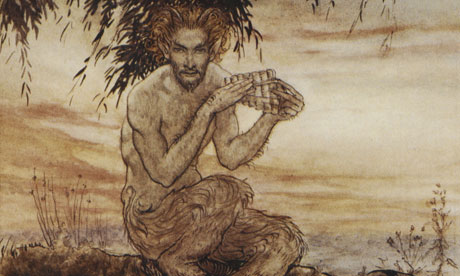
You may not be surprised to learn the person who decides to hang on to 400-odd picture books might be in the market for the most delightful edition of such a classic as The Wind in the Willows.  In fact, I occasionally troll Amazon.com for new editions of many favorites, especially those which are or can be illustrated.  Such a find was this:  last year for my birthday I bought myself the Collector’s Edition 2014 reprint of this book in a charming, small, hardback edition with gilt edges and the real feature—illustrations by Arthur Rackham.  (You may also not be surprised to learn I have favorite illustrators and a propensity to track down their work like a bloodhound.)  This particular edition also includes an introduction by A. A. Milne—another treasure—and I read it aloud to my kids too.  I reproduce the best part here:
“One can argue over the merits of most books, and in arguing understand the point of view of one’s opponent.  One may even come to the conclusion that possibly he is right after all.  One does not argue about The Wind in the Willows.  The young man gives it to the girl with whom he is in love, and if she does not like it, asks her to return his letters.  The older man tries it on his nephew, and alters his will accordingly.  The book is a test of character.” (10)
With that daunting description in mind, we returned to a book we (fortunately) all remembered loving.  But this time it was quite a different experience.  The first time I read it they were too young—maybe 5 and 7—and couldn’t follow the British expressions very well.  The second time was perfect—around 8 and 10—and everyone adored it.  They giggled in all the right places and loved the characters like real friends… like Christopher Robin loved Pooh and Piglet, now I think of it.  But this time they were big, and the book, we thought, had stayed little.  This was a return.
We began by remembering favorite scenes and characters.  Dad’s favorite characters were Ratty and Otter.  (Dad cares very much about character and less about symbolism or plot or setting.)  The girly remembered the least, being the youngest, and encouraged us to read the story and not reminisce.  The story begins with Mole, as he becomes disgruntled with spring cleaning and bursts out of his hole in to the sunshine, on the riverbank where the rest of the story will take place.  The girly was all over this.  “Oh my gosh, mom.  You’re so Moley.”  I don’t disagree with this statement, but I was curious.  Was it my lack of interest in housework or my jubilation in nature, as Mole “jump[s] off all his four legs at once, in the joy of living, and the delight of spring without its cleaning” (12), or something else she was responding to?  “All of it. Mostly your happy willingness to do stuff and to make everything an adventure.  Everything makes him happy.  That’s you.”  This was not going to be a reading like last time.
From that scene on, every time a new character was introduced, he (yes, all the characters are he’s) was immediately claimed or ascribed to another member of the family.  Dad IS Otter.  The girly thought she was Badger—an introvert who hides with his books in his little, cozy cave was what first attracted her, and as we got deeper she did not disown the problem-solving, authority-bearing figure Badger becomes.  She embraced it and took it as a logical corollary of the first description.  My son identified with Ratty—very much in the moment, deeply involved in his interests (“Ratty’s just a river-geek!”), and a kind and thoughtful friend.  No one owned up to Toady. J
This desire to find themselves in the text was not present when we read years ago.  There may have been an occasional acknowledgement that someone did something you admired, but not this kind of sustained argument.  My daughter was treating it like a thesis, hoping the character comparison would hold up for the entire book, so she wouldn’t be proven wrong and have to choose a new approach.  Every scene was potential evidence for her claim—or threatened to unravel it.
Along with that, I found both kids quick to censure Toad.  It wasn’t just that they didn’t want to identify with him; they thought he was a jerk, and from time to time got so exasperated with him, they wanted to skip scenes or at least a few lines.  I did not accommodate them this time.  Closer to the end, they found they still liked Toad, despite him being so hard to deal with, and through Toad’s friends’ patience with him, they learned to take him as he was too.  But they were not having any of his proclaimed “reformation” at the end.  They had made their peace with Toad and accepted his foibles better than his own friends.  They were better friends to Toad than Ratty or Badger in the end, and in some way their assimilation to characters in the book was complete.  This was a much more involved, much more personally engaged, and much more intellectually challenging experience than reading it had been six years ago.  I was delighted by the whole thing, and found new reasons to love an old favorite, as well as the process of reading together.  This was the last novel we read together, and we went out with a bang.  Our reading now will be sporadic, not religious, but we have had a glorious run.
      Kenneth Grahame.  The Wind in the Willows.  1908.  Arthur Rackham, illus.  The Collector’s Library Edition.  London:  CRW Publishing Limited, 2014.